
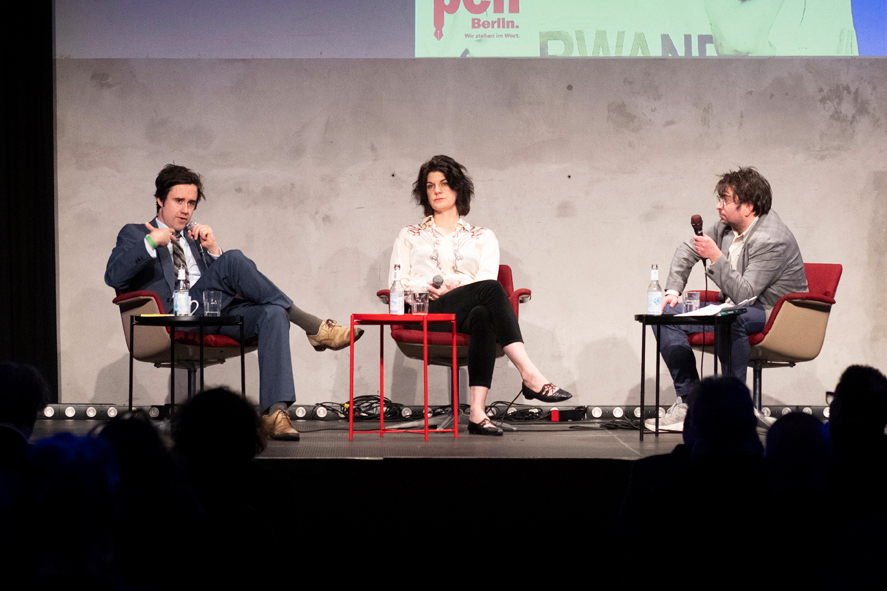
Keynote speech at the PEN Berlin Congress »Who’s Gonna Clean This Up?«
29 November 2025, Säälchen, Berlin
Before the Eyes of the World
By Sofi Oksanen
When I was a child, my Estonian cousins, a bit older than I was, began to worry about their height. Their father was short for a man, and my cousins wondered if they would remain just as short as he. However, this did not happen – Their father was a head shorter than me, but my cousins grew tall, much taller than me.
There was a reason for their father’s short stature. When the Soviet Union deported 20,073 people from Soviet-occupied Estonia in March 1949, he was one of them at the age of fourteen. Surviving Siberia by eating potato peels he lost centimeters in height, but returned home alive, unlike many others. Child mortality among the deported was high.
Although the camp system known as GULAG was intended to be eternal, it was dismantled after Stalin’s death in 1953 followed by the survivors returnal to the society after spending years in the camps. Majority of them didn’t have a home to return to. What they had owned had been confiscated. In Estonia Russian settlers had move to live in their homes.
In Siberia, my uncle had learned fluent Russian, like other deported, but that didn’t help with he problem he faced when he returned to his homecountry: because his schooling had ended with the deportation, he didn’t have a certificate of completion of basic education, which was required for further studies, vocational training included. It was also required to get a job. Eventually, he managed to enroll in a driving school having found a one lead by a director feeling empathy towards former inmates. Not everyone was so understanding – many shunned those who had the stigma of enemies of the people. But with a driver’s license, my uncle managed to secure a job in a logging site and started to drive a log truck.
My uncle wasn’t deported because he had DONE anything. As a teenage boy he had not participated in the anti-Soviet activities; he was not a »Forest Brother« like my grandfather, a resistance fighter. He wasn’t like my grandmother’s brothers, who had taken up arms against the occupying forces and died while being hunted by the NKVD, the Soviet security service. Nor was he like my grandfather’s brother either, who was also deported – but as an adult man – and whose records at least contained a legal clause stating he had been sentenced for crimes against the Soviet Union, along with the date of his sentencing. However, my uncle was never convicted of anything in the Soviet show trials.
He was taken as a child for one reason only: he was Estonian – the son of Estonian parents, and a child of a man who had already been sent to the camps years earlier for opposing Soviet occupation.
The stigma of deportation
The stigma of being deported followed my uncle throughout his life and that was the case with all deported people. During the perestroika many of them were rehabilitated, but when that happened, my uncle was already retired. Nevertheless, the Soviet terror could finally be addressed publicly.
Before it could only be spoken of in trusted company and even with them we used euphemisms, like »the cold country« instead of words like deportations. We talked about people who »were taken« and nobody needed to say where they were taken, we all knew.
When Russia’s large-scale invasion to Ukraine brought deportations of Ukrainian children to light, the issue garnered global attention. However, I was astonished at how swiftly the topic vanished from media coverage and policymakers’ discussions. I recently met a journalist who was surprised after my speech about deportations, because she thought that the problem must have already been solved, and when I asked why did she think so she answered that if something like that happens we expect authorities and officials to solve the issue, and if it’s not in the news, you expect they have done so, because otherwise we would have follow-ups on regular basis, right?
Ever since Russia started the deportations after occupying Crimean peninsula in 2014 I have been trying to understand, why this crime is paid so little attention. By far around 35 000 Ukrainian children have been deported to Russia, and only few of them have managed to return.
Protection between the lines
During the Soviet occupation of Baltic States the language of eufphemism and writing between the lines was for our protection, but maybe it was also one of the reasons why Western countries have been so vague with their response. Because of the Iron Curtain we lost fifty years of consolidating our history, it’s big events, big narrations into Western counsciousness. After regaining the independency Estonians started the decolonization process of the Soviet language right away, but now it’s quite clear it wasn’t enough, and how could it be?
Western countries adopted the colonial Russian gaze over Eastern Europe already during the Tsarist Russia and the Soviet era didn’t change that. In Baltic countries deportations belong to the most important identity stories, but for the rest of the West they don’t exits, or they are mere local stories. The former Eastern Bloc – which makes half of Europe, experienced the rule of two different totalitarian systems, and even so, our experience remains to be recognised in the common narrative of the European continent. It never became a historical memory of Europe as a whole.
Ukrainians were right to start call deportations kidnappings and abductions, when they started to take place. These words are clear, precise and understandable. The choice of words was smart, because Ukrainians needed to convey the information about what was happening in a way accessible also to those who knew nothing of Ukraine’s history, the past deportations, to those who had adopted the Russian gaze without being aware of it, and I thought I should’ve started myself to use those exact words when I began to write about this very same subject matter over twenty years ago.
But I couldn’t have done so at the time, becuase when my first books were published in the 2000s, Russia had already started its fight against history and facts and therefore I had to use words the historians and researches already used. I had to make it very clear that I wrote about events that had happened in real life, crimes that had been researched by international, independent researchers.
Mocking the victims
Part of Russia’s project of denying the nature of deportations was mocking the victims. When the trials of those who participated in deportations in Estonia took place, Russian media turned the trials into a propaganda circus where Russian kids brought carnations to the perpertrators and called them heros. I’m sure you can imagine what that felt like when I say that we take denying deportations just as seriusly as denying Holocaust. However, now I feel that nobody else took these Russian disinformation campaigns seriously.
The Kremlin saw that as a sign of silent approval, which couraged them to believe the response would be the same with the next deportations, and when they started to take place in Ukraine, Russia even used exactly the same words putinist activists had used when I started to write about mass deportations of the 40s. They called them summer camps and summer vacations. Now Russia steals Ukrainian kids under the pretense of vacations and summer camps, and they do that because nobody on the international scene told Russia to stop distorting historical events.
Denying the nature of past deportations was so important to the Russian Federation that spreading information about these human rights crimes in now a crime in Russia.

In 2014, when Russia annexed the Crimean Peninsula, glorification of the Soviet Union was written into the criminal code of the Russian Federation: it is a crime to spread »false information« about the actions of the Soviet Union during World War II. From our point of view this means for example denying spreading information about our deportation experience.
The 2020 constitutional amendments were a war cry, which inevitably would have led to an escalation of fighting in Ukraine sooner or later, since they deny Ukraine’s independence. Article 67.1 incorporated the Constitution of the Russian Federation into the »thousand-year history« of Russia, a reference to the era of the kingdom of Kievan Rus’ (862–1242), which preceded Russia and the Ukraine of today. According to Russia’s fabricated history, Kievan Rus’ means that Russians, Ukrainians, and Belarusians belong to one unified people. In this projection of history, Russia, Ukraine, and Belarus are not independent nations but rather subpopulations of Kievan Rus’ that make up the Russian Federation.
Article 67 of the Russian Federation Constitution references honoring the memory of »defenders of the motherland« and defending »historical truth«.
The development has been the opposite to the years of perestroika, when the deportations were declared illegal, criminal acts of the Stalinist regime by the Soviet government, first in 1956 and then 1989–1991.
However, Russia’s oldest human rights organisation honouring the memory of the victims of the Soviet crimes and collecting data, Memorial, was first announced Foreign Agent in 2015 and in 2021 Moscow City Court orderd the dissolution of the organisation. The accusation claimed that Memorial »creates a false image of the Soviet Union as a terrorist state«.
The deportations of the present
All this eased the legal path for future deportations and re-education of Ukrainian children. Updating traditional deportation policies doesn’t happen overnight. It requires long-term planning, and when Russia began its large-scale invasion, the plan to abduct Ukrainian children was already in place.
While such actions contravene international law, they have been legalized within Russian Federation. Over the past two years, Putin has personally overseen legislative changes facilitating the rapid naturalization of Ukrainian children and allocated federal resources to support this initiative. Facilities under the Presidential Administration have housed these children, and the President’s office has financed adoption databases. Security agencies and their involvement have been integral to the operation.
It’s not the first time Ukraine is facing these ordeals by the very same aggressor. Ukrainians endured three waves of deportations aimed at de-Ukrainization between 1925 and 1941, during which approximately 10–20% of the population was displaced. In Estonia, the first mass deportation occurred in June 1941, with about one-third of the deportees being children and minors. The March deportations which took my uncle to the camps mirrored this ratio. Similar operations were conducted concurrently in other Soviet-occupied Baltic states and even before the Soviet Union, the imperial Russia did use large-scale deportations to serve its imperial aspirations.
They also stole kids from Finland. Published in 1852 and written by Zacharias Topelius, our national tale The Birch and the North Star is based on the true story of kids abducted to Russia for slaves during the Russian occupation of the country. But at the time they didn’t have railroads suitable for mass deportations like they did later on. And in 1940s they didn’t have planes enough to deport tens of thousands of people, but they had railroad and cattle cars. The system does evolve: deported people are send to where they are needed. In 1940s they needed inmates for the mines and rail road constructions. Now due to the demographic problems they are focusing on kids and Instead of isolating the deported in camps or in exile as was done before, they are assimilated into Russian society. Both ways are however aiming for the same goal: the erasure of the national identity of the targeted groups and that is why the nature of these practices is genocidal.
Today, forced relocations remain a fundamental component of Russia’s imperial playbook. Following the purge of populations undesirable for occupying forces, the next phase involves the assimilation and Russification of those who remain. Russian settlers are brought in to replace the deported communities. This was the method they used to occupy the Baltic states, and it is the approach Russia employs now in the territories it has seized from Ukraine. In 1945, when the West celebrated the ending of the second world War and Estonia’s second Soviet occupation had started, 97,3 perfecnt of Estonia’s population were Estonians. In 1989 the Estonian population had dropped down to 61,5 percent.
This shows the efficiency of Russia’s method of colonisation, and yet it was not at all discussed during my school years. When I was doing research for my debut novel, Google searches gave me nothing about Russian colonialism, let alone decolonisation. During my university years in Helsinki, Finland, there was nothing about Russian colonialism in my recommended reading lists. When I did my gender studies, decolonisation was the word of the hour, but that didn’t include Russia nor the Eastern Europe. It was all about Western maritime imperialism. Not the Eastern settler colonialism practised on horseback.
Cause of war: identity politics
The situation is better now, thanks to Ukraine, but you don’t decolonize Russian gaze in a few years. When I asked my Ukrainian friend, why does she think the WEstern response to deportations is so vague, she gave a bleak answer: »They still think we’re Russians.« If that is the case, Russia’s colonial assimilation politics is much more efficient than you think, because it doesn’t only affect people on Russian-controlled territories, but also people living outside Russia. It has affected your thinking, your world view, values and moral code.
Russia’s colonial politics is so efficient that majority of the Western war talk doesn’t highlight at all the very center of the war, the root causes of the war, to which the deportations are very much tied. to. This is precisely why the fixation of peace rhetoric on border kilometers is a path that does not lead to a sustainable and just peace. At the heart of the war is identity politics: Ukrainians are not Russians and do not want to become Russians, while Russia wants to force Ukrainians to become Russians at any cost. That is why these child abductions are in the very center of it: Russia is stealing Ukrainian kids to re-educate them to be Russians, and they are not even hiding it.
That is different compared to mass deportations of 1940s. In the Soviet Union, deportations were easy to hide from the world. Communication with the outside world was cut off, mail was sencored, deportation trains could not be approached even by bicycle or on foot, and drawing near them was prohibited, let alone taking photographs. Now, the whole world has been able to observe Russia’s actions; satellite imagery has captured buses waiting at airports for children transported by presidential aircraft. That doesn’t seem to bother Russia. On the contrary. They are taking advantage of the visibility of the actions by portraying the deportations as »evacuations« or »rescues«.
This tactic of disguising child abductions as acts of charity aligns with a broader narrative promoted by the Kremlin, positioning Russia as a savior. Therefore, saving the children is a narrative serving also domestic political purposes, seeking public support for actions it calls a »special military operation«.
This publicity might be also part of the reason to the weak response by the Western countries. Maybe presidential plane too obscure vehicle for kidnapping children? Or maybe it has something to do with the mere fact that these crimes are committed in broad daylight with no shame? Because how could anyone commit a crime in daylight?
Or maybe with all this visibility, hundreds of so called recreational camps and presidential planes Russia is exploiting the legend of big lie, presented by Adolf Hitler according to whom people could be induced to believe so colossal a lie because they would not believe that someone »could have the impudence to distort the truth so infamously«.
Hardly any books about the crimes of the Soviet Union
Or maybe the weak reaction is caused by simply the fact that the Westerners don’t recognise the crime here. And if you are not able identify the crime, you will not know how to respond to it.
We possess an enormous number of public narratives about Nazi crimes.
Every year countless new titles appear all over the world – because, as one publisher once said, Nazis always sell. Streaming services release new films and series about Hitler’s Germany almost every month. Researchers continue to unearth new perspectives on the subject – and, apparently, they get the funding to pursue them, and rightly so.
Thanks to this cultural attention, we are able to recognize the dangers of nationalism – so long as Russia is not involved. Because Nazis fascinate, we can identify the signs of ethnic persecution – as long as the persecutor is not Russia. Our fascination with Nazism allows us to spot antisemitism, to react to racism, and we can do this only because we have learned to name these evils aloud, and because we share a collective moral understanding of them – at least in the Western world.
By contrast, the number of titles addressing the crimes of Communism, the Soviet Union, or Russia is incomparably smaller. The gap is vast. And if we want to close it, the task will take not years but generations.
Anyone doubting this imbalance can count for themselves: Search any database or streaming service and see how many works you find about the human-rights crimes of communist regimes – and how many about the Nazis.
Everyone knows who Mengele is, but could you give a single name of the doctors who worked on poison labs or human test labs in the USSR? How many books have you read about human radiation tests on Gulag-inmates in Soviet Union? How many movies have you seen about this subject? What about Soviet Union’s poison laboratories? Everyone knows and rightly so who Anne Frank is, but could anyone name a child who was deported to Siberia and lost her life there?
Our moral code is shaped by public narratives – by books, films, television series, news, and reports. Art.
No opinions without narratives
When there are not enough public stories about a certain crime, politicians, journalists, and leaders cannot form clear opinions. Their decisions become vague, hesistant, weak. Every single published title is evidence of the importance of the subject. If the list of titles is smaller, the subject also seems smaller. Less important.
Of course we do have academic research on deportations and over the years I’ve attended multiple conferences on communist crimes, but it wasn’t until the latest deportations and the weak response to them I understood that I had been in a bubble while meeting with colleagues writing about the same topics. Research on a spesific field doesn’t translate into general consciousness. Information is not knowledge. Knowledge doesn’t equal with common understanding.
Without an awareness of these crimes, you cannot recognize the warning signs and you cannot do that if you dont’t see the historical connection of present deportations and the past ones. If your don’t know, that this has happened before, multiple times, you can’t see the pattern, you can’t see the context, you can’t see the tradition supporting the practice, and if you don’t see that, you don’t see that not only we need to bring deported people back from Russia but we also need to stop this practice destroying 80-year-old legal shield that has protected children.
The Geneva Conventions were created to ensure that children could not be treated like prisoners of war or spies. Specifically The fourth Geneva Convention includs provisions offering special protections for children. When Putin’s administration ignores international treaties concerning children, the Kremlin wants to demonstrate that rules and agreements do not matter, and if we ignore these crimes, Russia’s example will set a precedent for other nations to act similarly.
We’ve all heard leaders repeting the words of Donald Trump, »#Stop killing«, like a mantra. But have you heard anyone saying »Stop deportations«? I haven’t. No one has said that. The mass deportation that tore my uncle from his home took place in the Baltic states in 1949 – years after the West had celebrated the end of World War II. His father was also deported after Victory Day. My grandfather’s brother was likewise deported years after the war’s end was celebrated here. The peace or ceasefire does not somehow automatically stop Russia deporting Ukrainians. Occupation is a continuation of the war and even though you might think that stopping the hot war ends the suffering, it doesn’t – it just makes is invisible to you.

Russia keeps repeating to use this instrument of demographic engineering, because it can. Because of it’s impunity on these crimes. Because it’s demographic situation is not getting better and it needs children. It needs children growing men to fight it’s wars and women giving birth to its future soldiers, and that is why this is also your problem.
Even if you might not be able identify the crime, that doesn’t mean the crime doesn’t concern you, and this is exactly what I think is part of the problem. You might feel sorry for the Ukrainian parents who have lost their children, but you don’t think it could happen to you. You don’t see Russian soldiers wearing baclavas and forcing your kids to a bus at gun point. You think things like that cannot happen to you in the middle of Europe. But if you think it doesn’t concern you, you’re missing Russia’s motivation to steal Ukrainian children.
When the Winter War started in 1939 and the Soviet Union tried to invade, the majority of the Red army soldiers were not Russian. Oh. no, no, their were from the colonies, many of them Ukrainians, because the Kremlin protects central power, it protects Moscovites, it wants to keep colonies weak, and and that is why they like to send ethnic minoroties of the empire to fight their wars.
They are using Ukrainian children as pawns, to break down the resistance in Ukraine, but they are also stealing kids from Ukraine to turn them into new Russian soldiers. They are stealing Ukrainian kids to cultivate a new generation of soldiers to fight against you, your children or your grandchildren. They are re-educating the kidnapped kids to hate the West. To hate you.
Manuscript version of the opening speech delivered by Sofi Oksanen on Saturday, 29 November 2025 at the PEN Berlin Congress at Säälchen. Translated from the English by Ingo Herzke
* Sofi Oksanen, born in 1977 in Jyväskylä (Finland), is a Finnish-Estonian writer and playwright. Her novel Purge has received several literary awards. Most recently published in German is the essay »Putin’s War Against Women« (Kiepenheuer & Witsch, 2024)