
Opening speech at the PEN Berlin Congress »Who’s Gonna Clean This Up?«
29 November 2025, Säälchen, Berlin
Why are you doing this to yourself?
By Thea Dorn
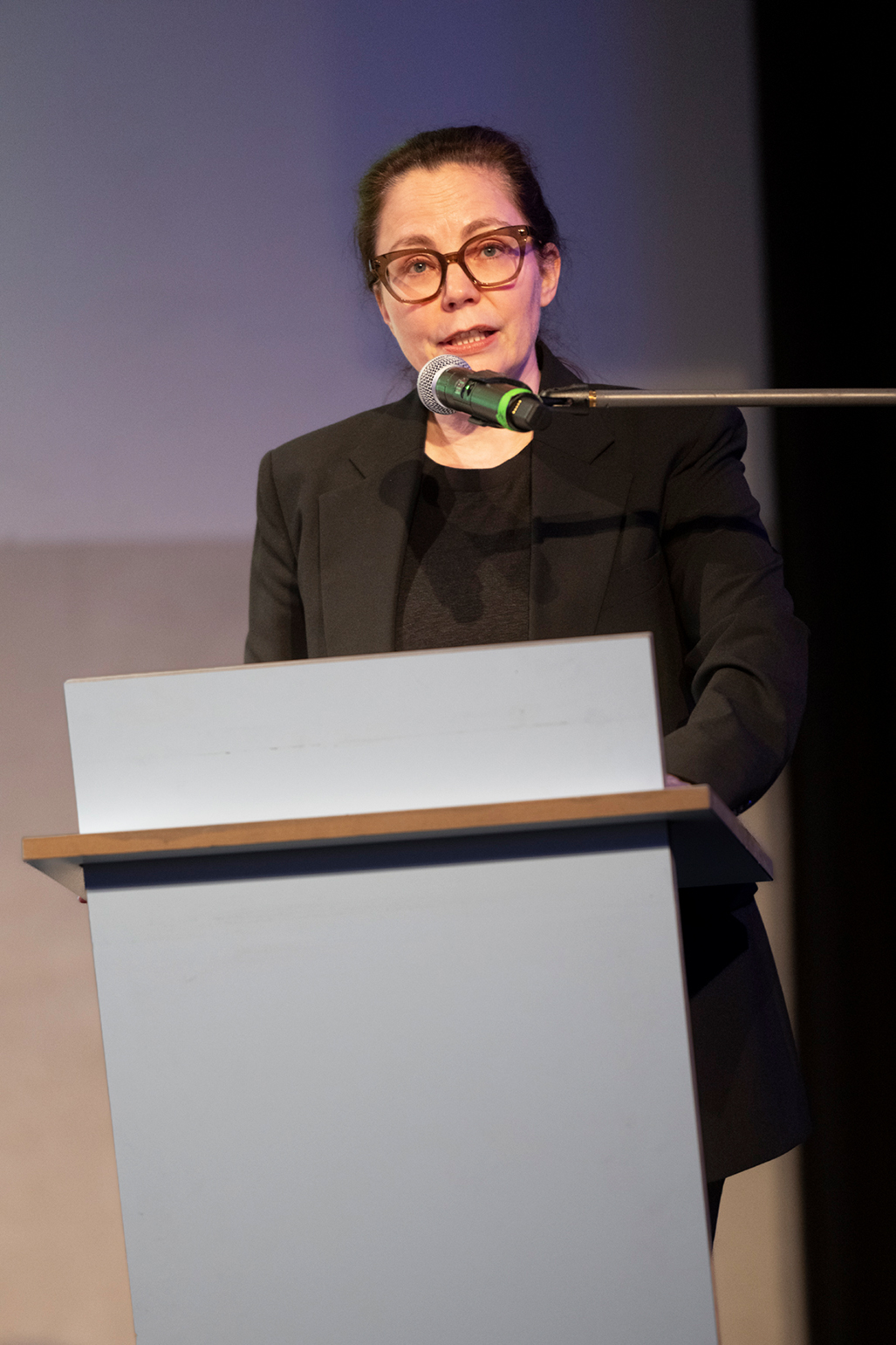
Since I took on the position of PEN Berlin spokesperson a year ago, there has been one question I’m asked again and again: »Why are you doing this to yourself?« And there are indeed moments when I ask myself the same. That’s why I want to use my speech as an occasion to actually think about why I’m doing this to myself, instead of brushing the question off – depending on the day – anywhere between a shrug and irritation, or calling out: »Well, because it’s insane fun!«
I suspect that decisions which change everyday life as dramatically as the one I made a year ago usually have something to do with one’s own life story. Still, I don’t want to stage an autobiographical navel-gaze here. Because I suspect my decision has just as much to do with more general constellations of our time. That’s why I hope that reflections on the question of why a person who already has more than enough to do in their private and professional life takes on an energy- and time-intensive (I do not say: time-stealing) honorary office – that reflections on this question might be of broader interest.
Perhaps I’ll begin with the life fallacy that wasn’t only my personal life fallacy, but is likely the life fallacy of most people who had the – seen from the perspective of human history and globally – improbable good fortune to grow up in a liberal-democratic polity. The fallacy goes like this: Once installed, the liberal-democratic state is a bit like the Duracell bunny. As long as nobody messes with the basic construction – separation of powers and free elections – economic growth and/or tax revenues suffice, and the bunny runs and runs and runs. Though of course the bunny is really more like a little house in which each of us can settle in as we please.
When the Duracell bunny stutters
Less cutely put: that is precisely what the liberalism of liberal democracies consists in: that they largely leave individuals alone; that they want as little as possible from us; that we can devote all our energy to somehow making the best of our respective lives – professionally, privately. Liberal democracies are enabling spaces that the individual should feel as little as possible.
If you describe the situation of democratic states like this, it becomes clearer where the bad mood has been coming from for a while now. The Duracell bunny has started to stutter. The enabling space that functioned so discreetly in the background for decades suddenly makes itself felt in a disruptive way: here, the light no longer comes on when you flip the switch; there, nobody responds anymore when you ring the bell. No wonder the disgruntled citizen – or should I just say right away: the disgruntled customer? – increasingly bangs on all sorts of buttons – only to experience that the service doesn’t improve as a result.
The people up there should finally deliver, the enraged citizen-customer thinks. And the people up there still don’t deliver, but they never tire of bowing and promising improvement, because isn’t it said: »Here, the customer is king?« And if, in the service-state, the citizen is less citizen than customer, then isn’t the citizen the secret, true king?
Perhaps the image of the citizen as king is less absurd than it seems in service-democracy. That parts of humanity set out on the adventure »democracy« two-and-a-half thousand years ago in Athens, and then again around 250 years ago in Europe and the US, likely did have a lot to do with the idea that people are not on this earth to be subjects. »Down with the kings!« has always been the battle cry of democratic revolutionaries – implemented sometimes brutally, sometimes in a more throat-saving manner. In that sense it is not entirely wrong to claim that in the moment the citizen, the people, raises itself to sovereignty, the citizen, the people, becomes king. But what does that mean? Is the citizen, as part of the sovereign, a capricious, hot-tempered, childish king? Or is he prepared to understand his sovereignty as a mandate, as an obligation – to not behave like a capricious, hot-tempered child, but to grasp that responsibility for whether the commonwealth fares well or badly also lies in his hands?
An attempt to escape civic despair
»Ms Dorn, couldn’t you make it a notch smaller?«, one could of course ask at this point. »Do you really imagine you are contributing to the welfare of the commonwealth by becoming the spokesperson of an authors’ association which may be fundamentally likeable and committed to a noble cause and thus officially recognised as non-profit, but which at times tends rather towards querulousness and theatre of sensitivities?« It takes a fair amount of craziness to take on this office, but no: I’m not quite that crazy. A PEN association is a PEN association is a PEN association.
And yet. If I had to put the past twelve months under a headline, it would read: »Attempt to escape civic paralysis«, or more correctly: »to escape civic despair«. Because yes: without being on the verge of despairing at the overall state of our democratically constituted commonwealth, perhaps even at the state of democracy as such – without that despair I would not have taken on this office.
But isn’t that already becoming far too big again? A clear case of tragic – or perhaps merely embarrassing – overestimation of oneself? Saving democracy with PEN Berlin – sure … But I ask myself as an author: isn’t overestimation our constant companion anyway? When we write and then even publish these texts, don’t we all believe that what we have to express, to communicate, is so relevant that someone out there is interested? If we come to the conviction that our texts no longer reach anyone, no longer achieve anything – don’t we then fall into despair, into a crisis of meaning and paralysis? But isn’t that precisely the moment that distinguishes the writer through and through from the occasional writer? The former keeps writing undeterred, because he has to write – even if it seems to make no sense anymore
We must awaken the citoyen within us
The logical conclusion from what I’ve just said would seem to be: then sit down and finally finish the longer democracy essay that has been lying around as a torso on your computer for a year and a half! My publisher would passionately agree with that conclusion. So why, instead of writing against despair as a writer ought to, throw yourself into an association office – which will presumably ensure that the essay remains a torso for another year? In order to find – perhaps – an answer to that, I must arrive at the sigh that regularly appears in conversations with those friends and acquaintances who don’t want to know »why I’m doing this to myself«, but on the contrary find it »absolutely wonderful«.
If the »why?« faction tends toward a sceptical to cynical, thus supposedly realistic attitude toward public engagement, the »wonderful« faction is fundamentally attached to a certain democratic idealism. However, as a rule it is at a loss as to what should concretely follow from this basic willingness to engage for the commonwealth. That’s why, with pleasing regularity, the sigh appears in these conversations: »One really ought to do something – but what, and how?« My equally regularly offered suggestion to translate the sigh into the maxim »We must awaken the citoyen within us« usually meets with great approval – but it doesn’t help in the matter either. Because how is it supposed to work in practice, to make the res publica, the »public thing«, one’s own thing?
Two-and-a-half thousand years ago in Athens it was still relatively clear how that works: everyone – meaning all adult, male, non-enslaved inhabitants of Athens who were moreover descended from two Athenians – came together regularly, regardless of their professions, to discuss the affairs of the polis jointly and decide what would be done. Indeed, Athenian democracy was so radically democratic that most political offices were simply and plainly allocated by lot. In other words: everyone had to reckon with the possibility that the lot of office might one day befall him.
If any Athenian had ever got the idea of asking another Athenian – who had just been elected, or selected by lot, into an office: »Why are you doing this to yourself?«, he would likely have been met with a fist in the face, or would have been hit with the indignant counter-question: »Do you take me for an idiot?«
In ancient Athens, an »idiot« was understood as anyone who conceived of being a citizen in the modern sense – someone who primarily wanted to be left alone by his community in order to pursue his professional and private life undisturbed. Now, Athenian democracy, exemplary as it was in terms of civic engagement, had some significant blemishes.
I’ve already hinted at the first: only those belonged to the citizenry who, in the process of Athens’ gradual democratization, managed to enforce their claims to participation and co-determination: first the men of the middle classes, later also those of the lower classes. Women, foreigners, and slaves had no say whatsoever even at the peak of Athenian democracy, and certainly nothing to co-decide.
The second blemish concerns the economic foundations of the permanently engaged citizen. You first have to be able to afford neglecting gainful work for days on end in order to devote yourself to the affairs of the commonwealth. Athens solved the problem by paying allowances not only for taking on a political office, but already for mere participation in the popular assembly. However, the money for those allowances had to come from somewhere – and the ugly truth is likely this: without Athens being a slaveholding society and without constantly waging war against someone, which meant spoils of war – which in turn meant even more slaves – the intensive democracy of citizen participation could never have been financed.
These first two blemishes hardly bothered any contemporary critic of Athenian democracy at all, or were by no means perceived as flaws. But from the very beginning, something else was indeed reproached against this daring model of organizing the government of a state from below: dilettantism. In shorthand, the reproach runs like this: when it comes to how to build a ship or how to treat an illness, I don’t convene Tom, Dick and Harry so they can discuss and decide what is to be done – or even draw lots to decide who will be doctor next year and who shipbuilder. Rather, I turn to experts.
So why should Tom, Dick and Harry be capable of making reasonable decisions that lead to reasonable actions precisely when it comes to the affairs of the entire commonwealth? The fourth blemish has to do with arithmetic. Also very briefly: if the 30,000 to 50,000 people who counted as citizens in Athens had actually all wanted to become politically active, the whole enterprise would have collapsed. And if the up to 6,000 participants each popular assembly is estimated to have had had actually all insisted on debating, the discussion of each agenda item would have taken several weeks.
Representation instead of participation
The American political scientist Robert A. Dahl captures this dilemma arising from number and time in the formula: »The more citizens a democratic unit contains, the less directly these citizens can be involved in governmental decision-making, and the more authority they must delegate to others.« Seen in this way, it seems virtually inevitable that, at the rebirth of democracy – which took place in territorial states, i.e. mass societies, and in which, moreover, the equality of all human beings was at least proclaimed as an ideal, meaning that in principle far more people would have been invited to debate and participate – under the conditions of modern democracies it seems inevitable that nothing can remain of the original ideal of immediate, engaged citizen participation that shapes individual everyday life.
Representation instead of participation seems to be the only possible consequence. Whoever comes to terms with this consequence must – if the crisis that democracy has entered in the 21st century gives them no peace – devote their energy to solving the problem of representation. But whoever is convinced that purely representative democracy, in the long run and even more so under the conditions of highly individualized, capitalist late modernity, can lead to nothing other than the soured expectation-management and service-democracy we have ended up in – has a much bigger problem on their hands.
I fear – you guessed it – I belong to the group of these unfortunates. Because if you sit with this conviction, aren’t you sitting in the perfect trap? Haven’t I just described that even there, where democracy was invented and tried out for the first time, what Hannah Arendt so beautifully calls »public happiness« stood on feet that were in part shaky, in part reprehensible? Under present-day conditions, must this happiness not finally become a chimera? And am I not at the same time a child – or more: a passionate advocate – of the liberal attitude that each should become blessed – or unblessed – after their own fashion? And part of the magic of becoming blessed-or-unblessed-after-one’s-own-fashion is, after all, a state that leaves me alone. But what if this enchanting state that leaves me alone marches toward an authoritarian state – as in the US, for example? Then mustn’t I engage – in order to ensure that this state leaves me alone tomorrow as well? Mustn’t I suddenly make the res publica my own concern?
Which would, however, land us once again at the sigh from earlier: »One ought to – but how?« Now that the intellectual hinterland has been explored a little, I dare to put a very steep thesis into the room. No, this association here, PEN Berlin, will not save democracy. But this association is currently one of the best possibilities to feel the zoon politikon within oneself, to experience what the »public happiness« Hannah Arendt spoke of might perhaps be. This association is, if you will, a peaceful, universalistically minded mini-Athens. That I climb to this image has another, deeper reason. In Germany there are more than 600,000 associations, organizations, NGOs in which citizens engage voluntarily; in which they experience week after week, sometimes day after day, that being a citizen does not exhaust itself in going to work in the morning in order to have a pleasant evening. But I dare to claim that there is currently no association in Germany that so consistently and comprehensively advocates for something without which there truly could never have been democracy: freedom of expression.
Parrhesia and pathos
One very last excursion into ancient Athens. Decades before the term »democracy« became established there, there was a pair of terms that outlined the uniquely new thing being risked there in the political sphere: isegoria and parrhesia. »Isegoria« meant the equal right to speak for all participants in the popular assembly. Much more difficult is the second term to translate: »parrhesia«. »Freedom of speech« is not wrong, but ultimately insufficient. Its full field of meaning ranged from the self-obligation to speak in the popular assembly as frankly as possible and as committed to truth as possible, all the way to the right not to have to fear reprisals if one exposed oneself and one’s opinions in this way.
The best way to understand the pathos of parrhesia is to let an Athenian speak for himself. It is a certain Diodotus, who had previously been badly attacked in the popular assembly by a certain Cleon. If we believe Thucydides, this Diodotus declared in the summer of 427 BC: »But the good citizen should not intimidate those who speak against him, but prove his proposals to be better, on equal terms; and a reasonable city will not bestow special honor on its best adviser, but neither will it diminish the honor already possessed; least of all should it punish the man who failed with his plan. It must not deprive him of his standing.«
When I read these sentences, I inevitably think of the state of what we are experiencing today and what no longer really deserves the name »culture of debate«. Intimidating the opponent has now become the norm. Instead of continuing to engage with the opponent’s positions, instead of proving one’s proposals to be better »on equal terms«, one hopes to prevail by »depriving the opponent of standing«, meaning: by insulting or openly defaming them.
This bad habit is not confined to those who seem to have made heckling their true purpose in life. The bad habit now appears in all sorts of political and ideological colors – or rather, adherents of the most diverse political and ideological stripes are astonishingly united in that they basically see only one thing anymore: red.
Not seeing red all the time
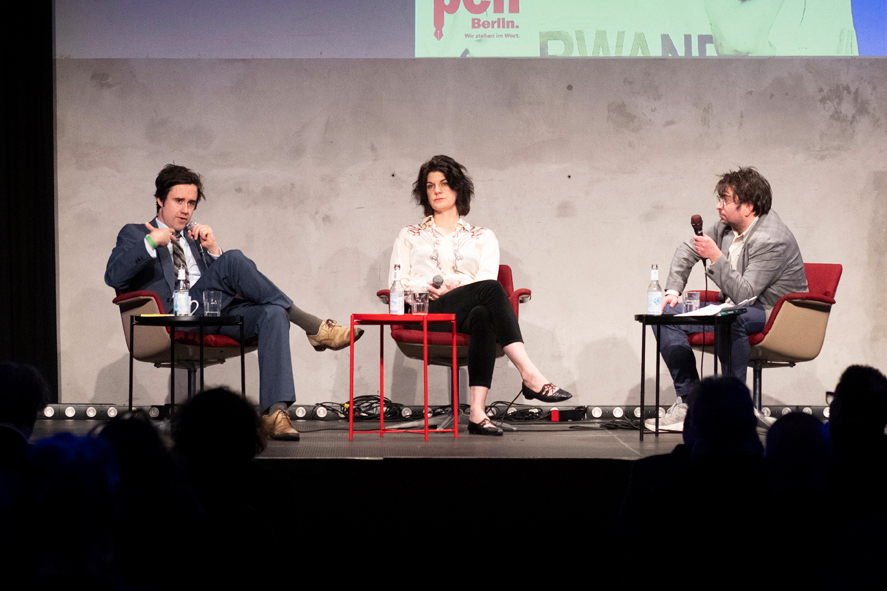
And with that I come to what, for me, is the soul of this association: no, not the »bickering« – but that we try not to see red all the time; that we take the idea of parrhesia seriously; that we endure it when other members of the association hold positions we ourselves believe to be wrong; that we engage with those other positions instead of insulting or defaming the person who holds them; that we do not demand that someone remove this impossible person from their place; that we do not ourselves leave the field with maximum indignant gesture.
Those among you who are familiar with what has been going on in this association will inevitably think of the conflict that, contrary to some sensational headlines, did not dismantle PEN Berlin, but did shake it repeatedly. I mean the conflict over the Middle East conflict.
To this day I’m not sure whether we succeeded, on the subject of the Gaza war – one of the subjects that most reliably ensures that people no longer talk and listen, but only insinuate and shout and insult – whether we managed to do better on this subject; or whether we, too, succumbed to the zeitgeist of aggressive intolerance, of intellectual and emotional self-concreting.
That we did not do better is suggested by the fact that quite a few members resigned for the most diverse reasons – some opposed, some in quiet disappointment, some in loud anger. That we did at least a little better is suggested by the fact that significantly more members than resigned in 2023/24 jointly drafted an open letter almost exactly a year ago, in which they affirmed their trust in PEN Berlin’s fundamental ability to do better; members who, I want to emphasize, also hold highly different positions on the question of how a thinking, feeling human being should look at the tragedy in Israel and in Gaza. These members behaved in a way that fits what I called the soul of this association: they did not ascribe the worst intentions and lowest motives to the other side; they did not defame the other side; they did not try to shove colleagues who hold a clear position but are not extremists into the extremist corner – or at least into the corner of those who »understand« extremism. For that, my heartfelt thanks.
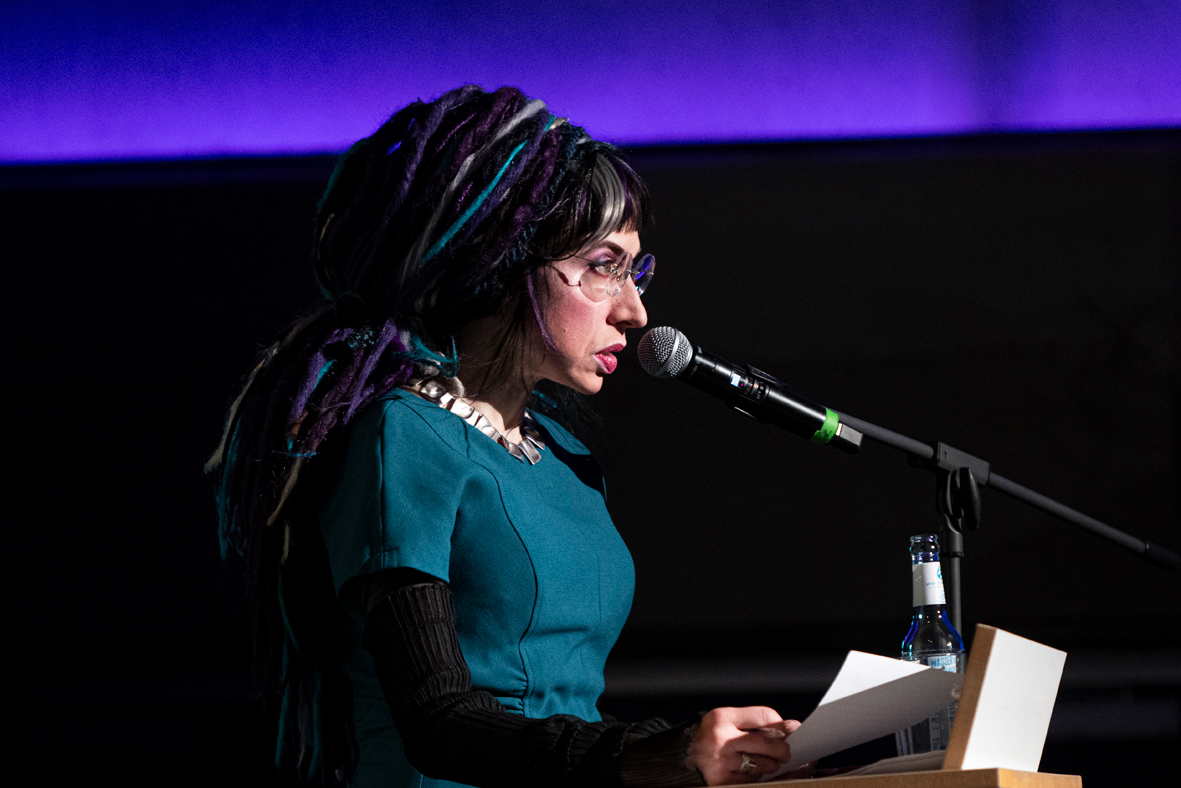
Nevertheless, we – i.e. Deniz Yücel and I, the entire board of PEN Berlin – asked ourselves whether we failed to develop formats, to initiate conversation events that would have prevented the pressure that has naturally built up in our association as well since 7 October 2023 from discharging in a dispute over a resolution. My personal conviction: yes, we failed. Conversation spaces can – startling insight! – best be kept open by using them; not necessarily by forcing a joint resolution at the end at all costs. I don’t want to deliver an activity report of the past twelve months here – that will come tomorrow at the general assembly – but I want to mention two PEN Berlin actions from this year because they seem to show me what the association can achieve when it succeeds in acting at the level of the problems.
Klütz: the market square as agora
PEN Berlin made the attempt to reopen a closing conversation space at the end of September in Klütz. Under pressure from local politics, the head of the local literature house »Uwe Johnson« had disinvited our founding member Michel Friedman from a planned event series – in memoriam Hannah Arendt – in autumn 2026. We reacted fairly quickly with a press statement in which we criticised the disinvitation – but without presuming to claim we knew which reasons or motives in the knot that has still not been fully untangled to this day actually led to the disinvitation. It also became very clear very quickly for us on the board: if Klütz disinvites Michel Friedman, we ask Michel Friedman whether he will come along when PEN Berlin invites him to a rally in Klütz.
There were concerns in advance about this rally – both among numerous residents of Klütz – Deniz and I spoke with some of them in the week before the rally in order to understand at least a little better how the disinvitation came about. But there were also concerns among some members of the association, who feared that the rally would be a typical know-better-Westie action. I hope that the way we organised the rally succeeded in convincing sceptics both in Klütz and in our association that we did not go there to lecture. Of course we went there to protest the disinvitation. But we also went there to discuss – above all with the 500 to 600 people who gathered on Klütz’s market square; a process that inspired Zeit Online to the formulation that the market square had become »truly an agora«.
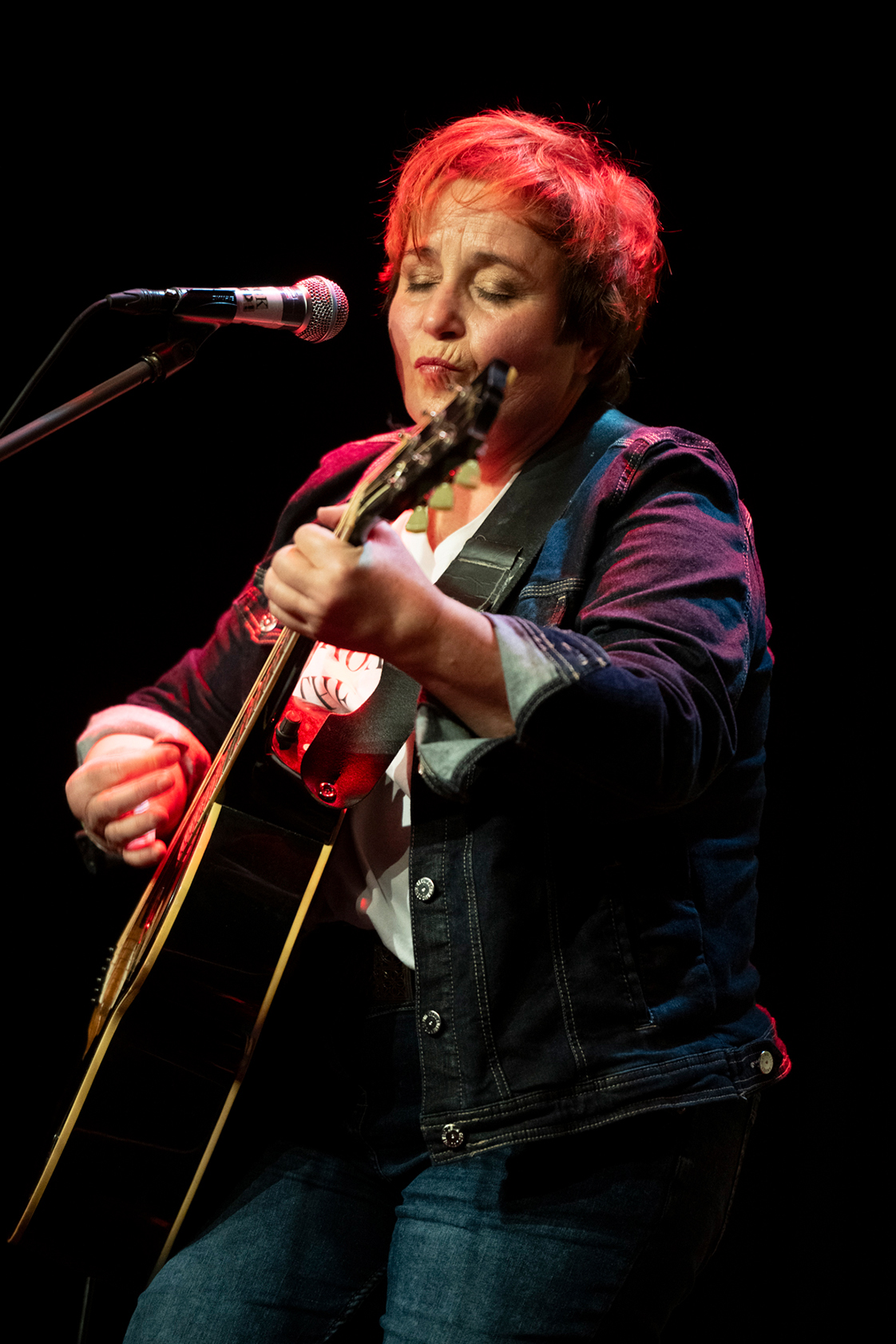
In the end, besides the notoriously embittered, there were in any case surprisingly many pleased, grateful faces to be seen. Perhaps these participants in the rally felt as I did: they experienced what happiness it can mean when, for once, a public dispute takes place that deserves the name; when loudmouths do not succeed in disrupting an event or preventing it outright; when hecklers do not succeed in dominating the tone. That the conflict between Klütz’s local politics and the head of the literature house ultimately did not find a constructive end was, of course, not gratifying. But tolerance, without which a democracy cannot function, also includes tolerance for frustration.
Boualem Sansal’s release
A high degree of frustration tolerance was required by the case that has occupied us at PEN Berlin over the past twelve months: the imprisonment of the Algerian-French writer Boualem Sansal in November 2024. The Algerian judiciary convicted him of »attack on national unity«, whereby the so-called »attack« consisted of nothing other than Boualem Sansal exercising his human right to freedom of expression. For a long time – far too long – it looked as if any protest, no matter from which side it came, would have no effect whatsoever on the rulers in Algiers.
That Boualem Sansal was finally released a good two weeks ago is owed to the quiet, persistent diplomacy of Federal President Frank-Walter Steinmeier and the Foreign Office. But I doubt that German politics would have taken up the case if PEN Berlin together with the German Publishers and Booksellers Association and also together with the German PEN Centre based in Darmstadt and other actors – if all these institutions had not jointly and persistently reminded people again and again of the fate of the colleague unjustly imprisoned in Algiers. And yes, it takes yet again a high degree of frustration tolerance when you realise that Sansal’s release was owed merely to a »pardon« and not to an acquittal, as it should have been; when you realise that writers and journalists worldwide still sit in prisons or are exposed to other state repression. Or when you realise that in numerous places in the world, authors and other lovers of freedom fight day after day for conditions in their authoritarian-ruled country to democratize – and we have to note that we can help only to a very limited extent, and that the German public and German politics are only to a very limited extent interested.
Simple answer to a difficult question
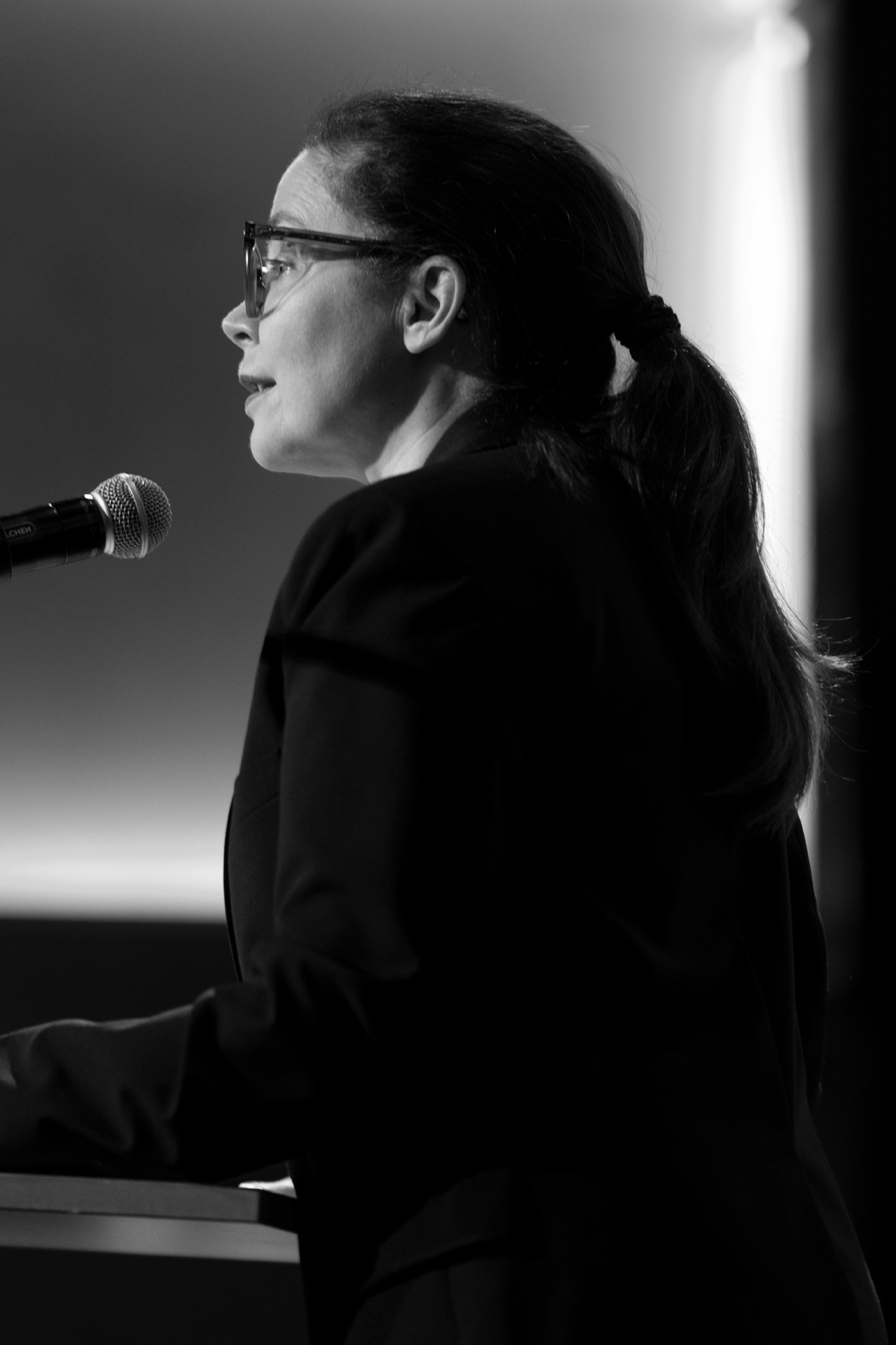
Much more frustration tolerance is needed when you see that the »migration turning point« proclaimed by Federal Interior Minister Alexander Dobrindt leads to the situation that not even people who risk their own lives in their countries of origin because they fight there for freedom and democracy receive humanitarian visas for a stay in Germany anymore. When you are confronted with all this daily and then also read about the umpteenth disinvitation of a »controversial« author or artist from some university, some festival, some something or other here at home, it can be hard at times not to answer the question »Why are you doing this to yourself?« with: »You’re right. It’s sheer Don Quixotism, what we’re doing.«
But when I look into the faces of those who demonstrated peacefully on the market square of Klütz and discussed with each other for almost two hours more or less civilly; when I protest together with fellow board members against the arbitrary arrest of a writer; when I meet colleagues who are persecuted in their countries of origin and whom we were able to help with visas and scholarships and – despite all adversities – still can; when I watch the first interview Boualem Sansal gave after his release – then the answer to the question »Why are you doing this to yourself?« suddenly becomes quite simple: »That’s why.«
Manuscript version of the opening speech delivered by Thea Dorn on Saturday, 29 November 2025 at the PEN Berlin Congress at Säälchen.
* Thea Dorn, born in 1970 in Offenbach, writer, essayist, host of the ZDF programme Das Literarische Quartett, PEN Berlin spokesperson since November 2024.