
Lead talk at the PEN Berlin Congress »Who’s Gonna Clean This Up?«
Audience debate: »Is there a right to hate?«
29 November 2025, Säälchen, Berlin
Democracy Can Tolerate More Than Some People Can Tolerate
By Wolfgang Kubicki
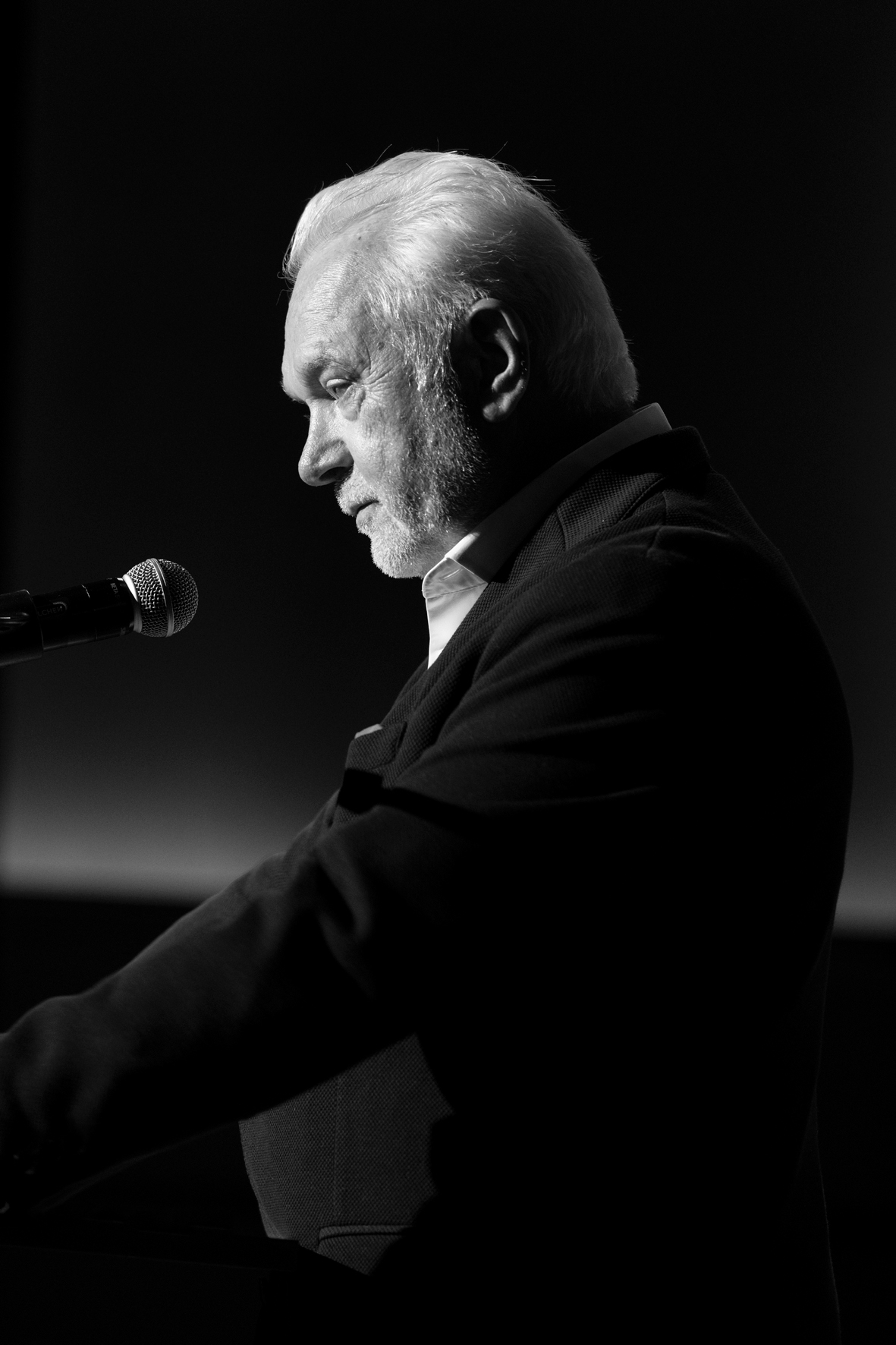
Let me begin by making one thing clear: hate is not a feeling I can recommend. It is a vile feeling that, over time, turns you bitter and, above all, humorless. That is why it never had the chance, in my case, to become the defining emotion.
Because – and now please listen closely – there is nothing I hate more than humorlessness. And there we already are at the essential core of the debate. For although I personally reject hate, there are things I cannot stand; things I flat-out reject, that I despise. For a long time, for example, pickled herring was one of those things.
That’s just how it is with feelings. They cannot be decreed. And, to begin with, that’s not a big deal. Some people may also have found, in a partnership, that the more solid and stable the partnership is, the less dangerous sentences like »I hate you« become – sentences that, in the heat of the moment, can indeed be traded back and forth.
If the partnership means nothing to you, you respond to such sentences with the accusation: »You have no right to hate!« If, by contrast, you care about making progress together, you might try the question: »Why?«
But even in the social sphere there is plenty of hate that no one with a healthy democratic mind would want to forbid. When demonstrators march through Berlin chanting »All of Berlin hates the CDU« or »All of Berlin hates the AfD«, I find that ridiculous – especially if the purpose of the demonstration is supposedly directed against »hate and agitation«. But everyone can make a fool of themselves as best they can. There is a right to that, too.
And finally – if I may already be a guest of a writers’ association – I would like to point out that art and culture are not driven only by love, but sometimes by hate as well.
In short: we can see that hate on its own is not a category particularly suited to judging human and social coexistence. And that is why it is no coincidence that our constitutional order sees it similarly.
Hate is not a legal category. There are consequences of hate, or forms in which hate is expressed, that are punishable. Under the criminal offence of incitement to hatred (Volksverhetzung), for example. Or under insult.
There is no right to incitement to hatred
So the sentence »There is no right to incitement to hatred« is correct. The sentence »There is no right to hate« is not. That is the legal situation.
But even with what we sanction under criminal law, a closer look is worthwhile. When were certain legislative decisions made? Simple insult, for example, has remained virtually unchanged since its introduction – despite all the criminal-law reforms since. It was introduced with the opening formula: »We Wilhelm, by the grace of God German Emperor, King of Prussia etc., hereby decree…«
That may be an indication that one could consider a more liberal solution. Another indication is that almost all Western democracies do not criminalize simple insult. Perhaps the protection of individual honor fits better in civil law, where we can derive other cease-and-desist claims without having to resolve them through criminal justice right away.
Criminal law policing convictions is a relic of dark days
For decades it was undisputed in left-liberal jurisprudence that criminal law policing convictions is a relic of past and dark days. In no criminal offence did this manifest itself as strongly as in the debate about the definition of murder. To this day, it essentially still has the form given to it by the Nazis – under the guidance of Roland Freisler.

It states, among other things: »A murderer is anyone who kills out of lust for murder, to satisfy sexual desire, out of greed, or otherwise out of base motives (…)« Here, »base motives« can undoubtedly be linked – also legally – to hate. Even so, until recently this was considered outdated by virtually all observers with a somewhat progressive mindset. To this day I share the position of the German Bar Association: in differentiating between murder and manslaughter, the decisive factor should be the degree of responsibility, not the perpetrator’s feelings.

With that position, however – unlike ten years ago – you now stand rather alone. For by now, calls for the codification of so-called »hate crimes« have become louder than calls to overcome this rather burdensome legal tradition. In that respect, people now want to free the definition of murder only linguistically from its historical burden, while leaving it unchanged at its core. This shift in the debate can certainly give one pause, as to whether we are truly moving forward in all debates about harsher criminal penalties – just because it sounds progressive on the surface.
So let us note: hate, in and of itself, is not a criminal-law category and is therefore not prohibited. Where it has an effect within criminal offences, one can certainly discuss – without pre-judging the outcome – to what extent that is appropriate.
And that brings us to the real crux: how much opinion can our democracy tolerate – analog or digital – beyond that?
The answer is simple: more than some people can tolerate. The Federal Constitutional Court made clear early on just how high the value of freedom of expression is. Not as a right granted by grace by the democratic state under the rule of law, but as its precondition! Free expression of opinion is »as a direct expression of the human personality in society one of the most noble human rights of all. For a liberal-democratic order it is constitutive in the strictest sense, because it alone makes possible the constant intellectual debate, the struggle of opinions, which is its vital element. In a certain sense it is the foundation of every freedom whatsoever.«
And of course these words make sense only if the limits are drawn as widely as possible.
Leaving the Federal Constitutional Court’s framework
The Federal Constitutional Court has done so again and again. For example in 2018. I quote: »Possible confrontation with unsettling opinions, even if they are dangerous in their intellectual consequence and even if they are aimed at a fundamental upheaval of the existing order, belongs to the essence of the liberal state. Protection against a ‚poisoning of the intellectual climate‘ is no more a ground for interference than protection of the population against an affront to their legal consciousness by totalitarian ideologies or an obviously false interpretation of history.«
We have left this framework with the Network Enforcement Act and the so-called »trusted flaggers« – and that is dangerous, because freedom of expression is, as I said, the precondition of freedom, not just any form of expression.
This is already evident from the guideline published by the Federal Network Agency. This list of guidance for extra-state review bodies contains the obvious, such as Holocaust denial or child pornography.
Also included on the list is »hate speech«, and that brings us right back to the beginning of the discussion. »Animal suffering« is also on it. I am curious whether the videos of animal-rights organizations that want to draw attention to abuses will be flagged when they publish corresponding videos.
And I am even more curious about the legal basis. The same applies to statements with »negative effects on civil discourse or elections«.
And what are »contents that promote eating disorders«? If one took that seriously, one would have to shut down a platform like Instagram. In any case, one hears more often that the body ideal presented and promoted there is not exactly healthy.
I have serious doubts that the view of humanity behind such efforts is compatible with that of the Basic Law. The latter sees the citizen as an autonomous person capable of making their own decisions, who does not need to be sheltered or protected from temptations; that is why everyone may also vote for whatever they want. They form their opinion. The constitution trusts them with that, and it wants that, too. And surely we should all want that as well.
Technological progress must lead to us carrying our liberal ideals over into the 21st century and, at best, developing them further toward an even freer society – not to throwing them overboard. But that is exactly the path we are on – and I will resist it for as long as I remain politically active!
* Wolfgang Kubicki, born in 1952 in Braunschweig, lawyer, economist, and politician. He was a member of the German Bundestag from 1990 to 1992 and from 2017 to 2025, serving as its Vice President from 2017 to 2025. From 1992 to 2017 he was a member of the parliament of Schleswig-Holstein. Since 2013 he has been Deputy Federal Chairman of the FDP.