
Lead talk on the PEN Berlin Congress »Who’s Gonna Clean This Up Now?«
Audience debate: »Is there a right to hate?«
29 November 2025, Säälchen, Berlin
Hate Is Not an Opinion
By Renate Künast
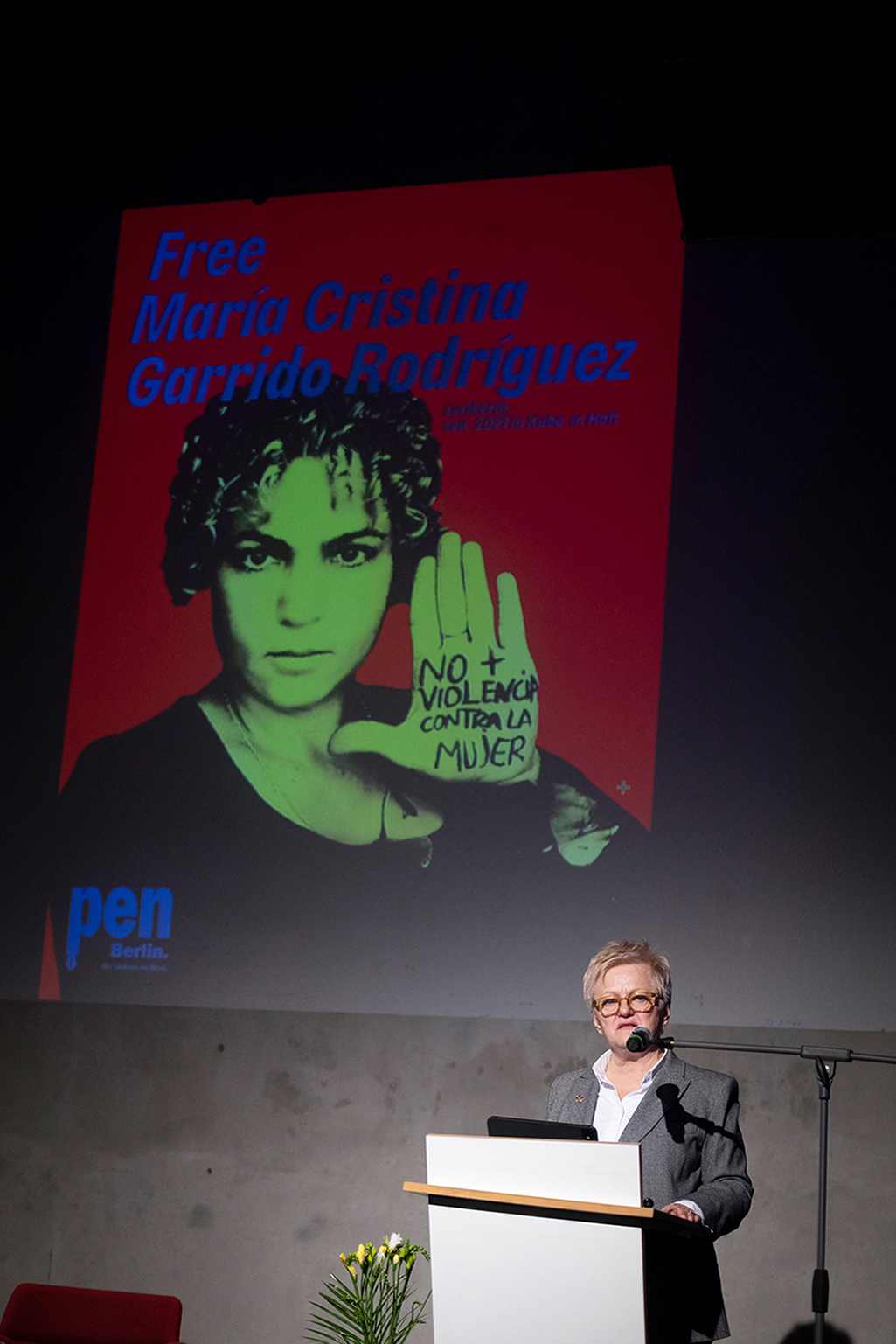
Where did it all begin, this entire debate? It began with the claim that in this country one can no longer express one’s opinion. And that escalated into hate. And when people then said that hate is not an opinion, not a contribution protected by the constitution, that too was criticised, and it was claimed that this, too, constituted a restriction of freedom of expression.
I think at this point we need to make the effort to differentiate and to draw a line between hate and opinion. Because: Not every criticism of power is hate, and criticism of power is permissible, even desired. And conversely: Hate does not serve the formation of opinion but rather the degradation of others. And that is how I separate the two.
Today, hate takes place under different conditions than those under which the Basic Law and its Article 5 were written and which defined the importance of freedom of expression and information.
Now it is the case that real hate is deliberately used by some individuals, but also by organisations, to delegitimise democratic institutions, constitutional bodies and individual persons active within them – I would include the media as a fourth estate – as well as the procedures themselves. One may harbour hate privately. But when one asks the question »Is there a right to hate?«, I must say: There is at least no right to express one’s hate without any limits or constraints, to demean others in the process. And this question is not trivial at all.
Sometimes people say that one is no longer allowed to express one’s opinion. Yet it is precisely those people whom I constantly see on social media, in podcasts and on TV talk shows, or in newspapers, magazines and newsletters, where they also say that one is no longer allowed to express one’s opinion. Something cannot be right there, ladies and gentlemen.
I also sometimes observe that this attitude can become a kind of career, even on television, in public broadcasting, which is itself criticised. We find that it is also part of a strategy to throw all these terms – hate, hate speech, false quotations, defamation – into one pot, to add the claim of freedom of expression, and to stir it all together in order to make us believe that it is all exactly the same.
It did not only begin with the claim that one can no longer express one’s opinion in order then to say something derogatory. It also began, and this is part of the broader strategy, with attacks on journalism – that is, the fourth estate – by calling it the »lying press«. If you consider the context of what right-wing extremists are doing in this society – they naturally want all constitutional bodies plus the fourth estate to lose credibility. That is why they attack not only these institutions but also the individuals within them.
And that is why they said: »Lying press«. Why? Because it serves their strategy of introducing their alternative facts. And when, somewhere, a UN organisation has commissioned 150 scientists worldwide to produce a scientific answer to a question, they come along and say: »But I know Mr Mayer-Müller, and he said something completely different, and by the way, he is the only independent scientist.«
If you are now wondering why the term »lying press« hardly appears anymore today – it is because it has done its job. This word has fulfilled its function; it has been planted within certain social circles, and the rest is done by the social media algorithm. That is where people get their information. And within the business model of outrage and agitation, there is also the fact that individuals talk about hate as opinion, about journalism as »lying press«, in order to implant their own content.
There, they also manipulate the algorithms of those who operate the platforms. There are many examples of this; listing them all would take longer than five minutes. But the algorithm is perfectly capable of amplifying such content – because more clicks mean more advertising revenue, and advertising funds no longer go to traditional journalism with its obligations but flow elsewhere. And there you find insults, defamation from within the country and from abroad, propaganda, and even attempts to influence elections.
Let me just mention Elon Musk or the Brexit referendum. Right-wing extremism was the first to use, to misuse, the digital mechanism. And when we talk about it, because Mr Kubicki mentioned that we are becoming thin-skinned – I think we sometimes need to differentiate. Of course, this also relates to youth protection when people, especially women, are encouraged to become ever thinner. That has nothing to do with major threats to democracy, but with a subset of state duties, namely youth protection.
Just as we must be cautious with tobacco smoking and alcohol and say: »We have a duty to establish youth protection rules«, we must also be attentive in the digital world to what is happening there. At the latest when young girls are encouraged, on the margins of games, to download nude images, we know what is at stake. Social media and the new forms of opinion that emerge there have both: opportunities, but also dangers.
There are now studies suggesting that people spend 60 hours per week on social media and are exposed there, for example, to large amounts of hate. I know many thought 60 hours cannot be true. But if you walk through the streets, you will see people crossing intersections like this, and then you will reach 60 hours if you already spend two hours each morning and evening on the way to school, university or work.
I believe we are facing a danger today, namely the danger of the misuse of language. Hate that is allegedly opinion – and indeed a danger to democracy and to individuals, who sometimes experience coordinated campaigns and are placed under psychological pressure and then hardly have the possibility to express their own opinions freely.
To distinguish once again between hate and freedom of expression, let me say what I mean: Let us return to the Basic Law. Freedom of expression is one of the most important fundamental rights. Why? Learning from Weimar, from National Socialism, it was recognised that democracy requires criticism of power.
And therefore freedom of expression is effectively its expression. A democracy allows criticism of power; it is, so to speak, designed to make this possible. Criticism of power may also be sharp, may be polemical, and we must say: »The state must endure this, members of parliament must endure this.« And indeed, state actors must not only endure it, they must actually protect it, because this kind of criticism of power is part of democracy.
But what is truly opinion? What is hate? And what is neither freedom of expression nor criticism of power, but rather the degradation of individuals?
J.D. Vance claimed at the Munich Security Conference: »In Europe you do not have freedom of expression, but in the USA you do.« I would like to point out one thing: in the USA there is not freedom of expression in the same sense, but Freedom of Speech. That is something different.
Freedom of Speech means that you may say everything that is in your head and heart without another person’s fundamental rights acting as a limit. Freedom of Speech means that one can invent things. For example, one can invent that Hillary Clinton ran a child pornography ring in the basement of a pizzeria.
That was the case in Trump’s first election campaign. One can invent all sorts of things and say them, demean people – that is Freedom of Speech, that is freedom of speech. Freedom of expression, which entails criticism of power, on the other hand, requires a certain connection to facts and is limited by the personal rights of others. It therefore does not extend indefinitely.
We know the relevant offences – incitement to hatred, defamation, false statements of fact, for example in Holocaust denial, the use of propaganda of unconstitutional organisations, and the violation of human dignity.
And then there is also insult. Like Wolfgang Kubicki, I would like to reflect on this. Twenty or thirty years ago I would have considered moving insult into civil law. But you must understand that in that case you would have to advance the costs yourself. Then you can only defend yourself against an insult if you first pay the legal costs, unlike in criminal proceedings.
Twenty or thirty years ago I might have done it. In today’s times, no – when right-wing extremism uses insult as its mildest but systematic and orchestrated means.
In this context, we have formal insults. And we also have insults where one must weigh freedom of expression against personal rights. I myself have taken such a case all the way to the Federal Constitutional Court.
And that Federal Constitutional Court established two things, in my view, correctly: first, that we have a public interest in protecting the personal rights of those who engage themselves for this community. It is in the public interest. That means that where a term is not automatically an insult, but where context must be established between freedom of expression and personal rights, one must also take into account that it is in the public interest that people see their personal rights protected. Otherwise, no one will engage any longer in this country, from youth sports coach to member of parliament.
And the second point, which I do not consider unimportant: today I would not tamper with the offence of insult. One must also take into account, ladies and gentlemen, that today the reach and repeatability in the digital sphere are virtually unlimited.
Transcribed and slightly edited version of the input lecture delivered by Renate Künast on 29 November 2025 at the PEN Berlin Congress.
* Renate Künast, born in 1955 in Recklinghausen, lawyer and former politician. From 2002 to 2025 she was a member of the Bundestag, from 2001 to 2005 Federal Minister of Food, Agriculture and Consumer Protection, 2000/01 federal chair of Bündnis 90/Die Grünen, from 2005 to 2013 chair of the parliamentary group.
RESPONSE BY WOLFGANG KUBICKI
ALL CONTRIBUTIONS AT THE CONGRESS